Solving Complex Problems Faster with Workshop Facilitation
Solve complex business and product challenges quickly by mapping user journeys, uncovering pain points, and facilitating collaborative workshops that turn ambiguity into clear, actionable solutions.
Introduction
Business problems often feel larger and more complicated than they really are. Teams can spend weeks discussing issues without fully understanding where the real friction lies.
A structured workshop can accelerate this process. By mapping the current journey, visualising pain points, and exploring opportunities together, teams can move from uncertainty to clarity in just a few hours.
Why Collaborative Workshops Work
Most companies already have a strong understanding of their operational challenges. The missing piece is often a clear way to unpack and visualise those challenges.
Facilitated workshops create a shared understanding of the problem, helping teams see how different parts of a process connect and where breakdowns occur.
“When teams can see the problem clearly, solutions emerge much faster.”
A Real Example
Earlier this week, I facilitated a focused 2.5-hour workshop with Mila and Andrew Aitchison from A11 Agency.
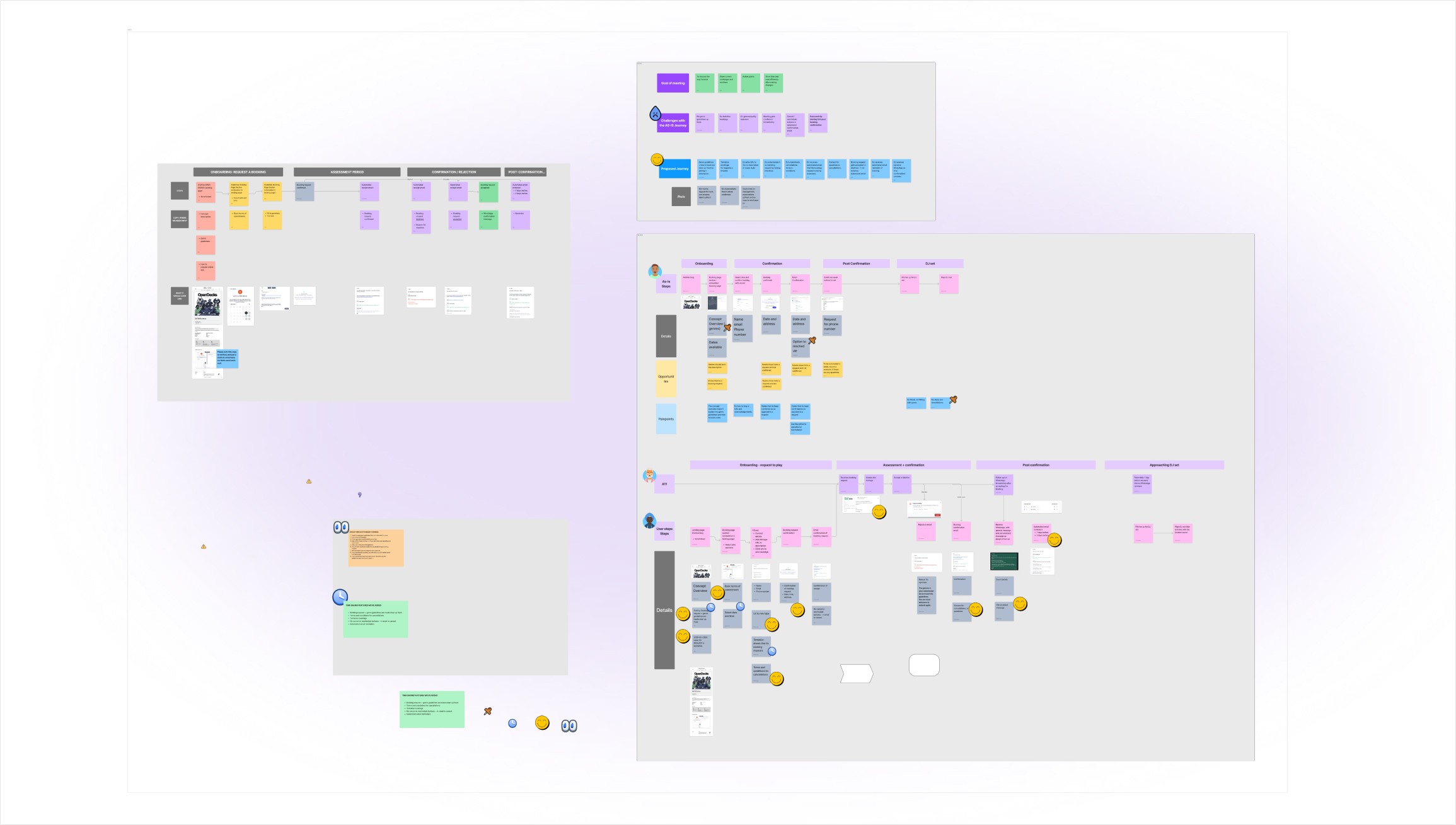
Together, we unpacked an operational challenge they were experiencing in one of their client’s booking flows. During the session, we mapped the current experience, defined the ideal user journey, and identified several pain points affecting both users and the business.
By the end of the workshop, we had generated around ten practical improvements to simplify the booking flow and create a better experience.
The Value of Mapping the Details
Documenting a process visually reveals the underlying logic, dependencies, and inconsistencies that are often hidden in day-to-day operations.
This level of detail helps teams:
Understand how each step connects
Identify bottlenecks and friction points
Assess the impact of proposed changes
Simplify complex journeys
Align stakeholders around a shared solution
What Businesses Often Discover
Many organisations already know where problems exist, but they struggle to articulate the root causes.
An external facilitator brings structure and objectivity, helping teams:
Ask the right questions
Visualise the problem clearly
Challenge assumptions
Prioritise improvements
Turn insights into actionable solutions
Tips for Running Effective Problem-Solving Workshops
Focus on one clearly defined challenge
Map the current state before designing the future state
Involve people with direct knowledge of the process
Capture pain points and opportunities visually
Prioritise ideas based on impact and effort
Conclusion
Complex problems do not always require long timelines to solve.
With the right people in the room and a structured approach to facilitation, it is possible to uncover root causes, align stakeholders, and identify meaningful improvements in just a few hours.
Sometimes the fastest way to solve a problem is simply to make it visible.